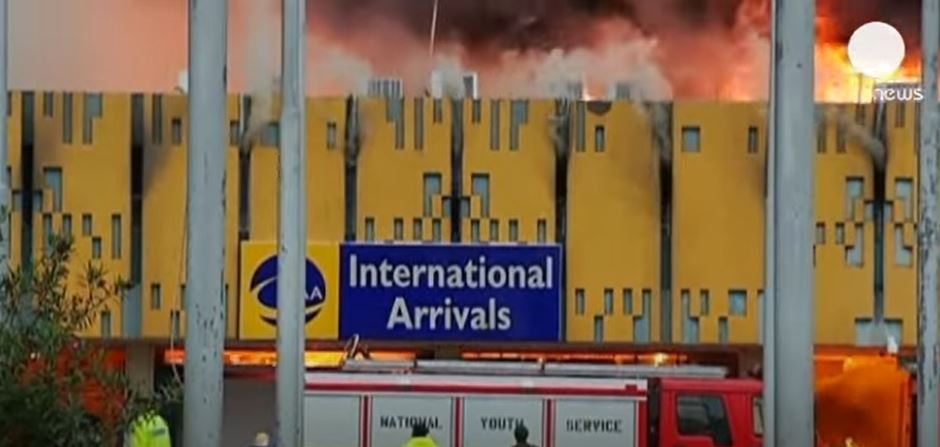

As of Tuesday, February 17, 2026 (EAT), industrial action linked to the Kenya Aviation Workers Union (KAWU) and a labour dispute with the Kenya Civil Aviation Authority (KCAA) has caused significant delays and operational disruption at Jomo Kenyatta International Airport (JKIA), with passengers reporting long waits and airlines warning customers to confirm flight status before going to the airport.
What started it?
On 9 February 2026, KAWU issued a 7-day strike notice citing:
- No new Collective Bargaining Agreement (CBA) since 2015, meaning pay and conditions have remained unchanged for years.
- Failure to deduct union dues for some staff who legally joined the union.
What did KCAA do?
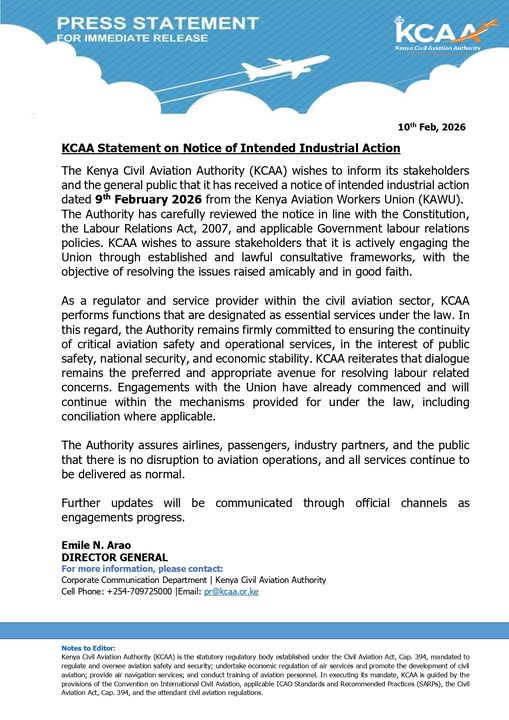
- On 10 February, KCAA confirmed receipt of the notice and said it was engaging the union through dialogue, stressing aviation is an essential service.
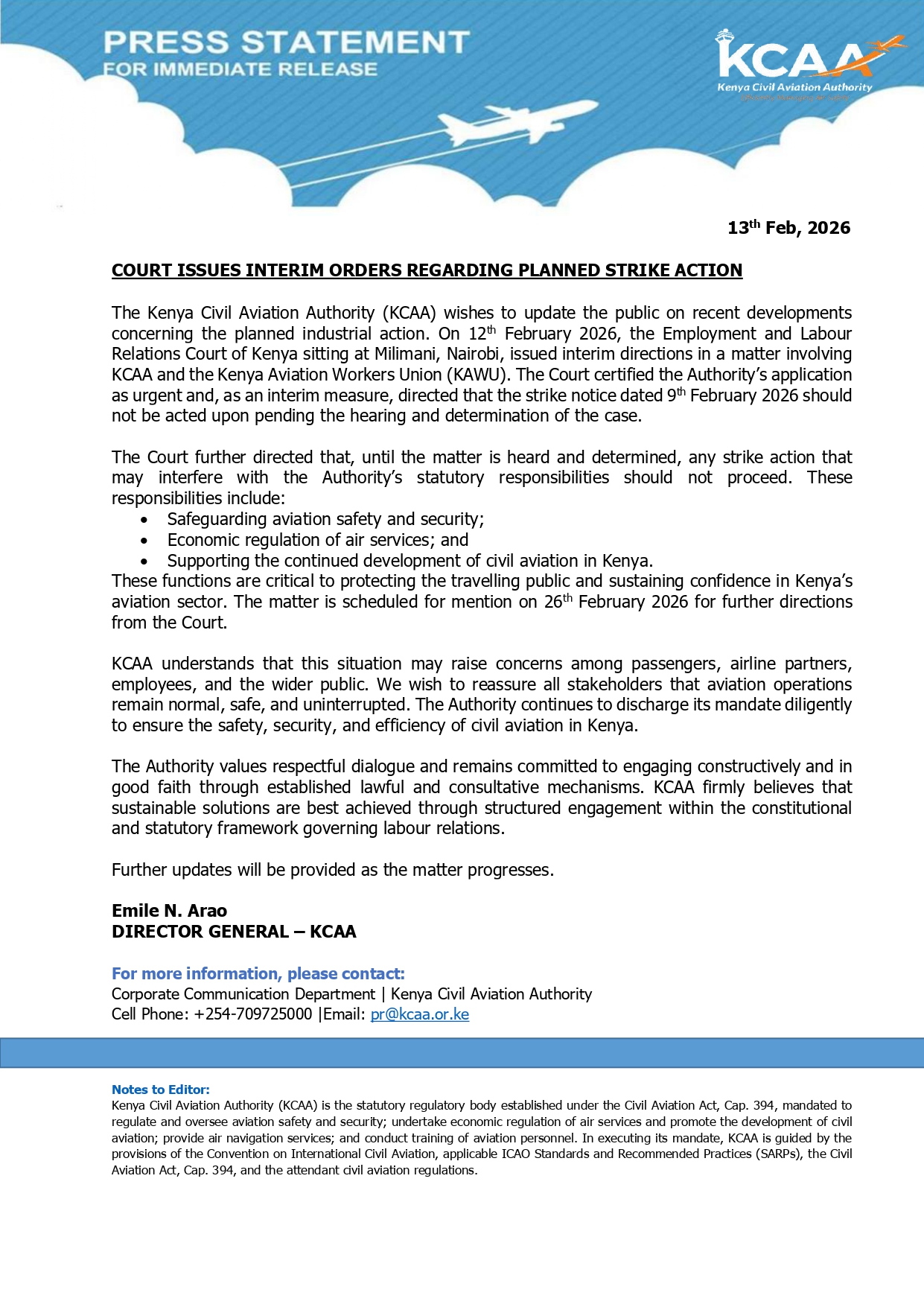
- On 12 February, the Employment and Labour Relations Court issued interim orders stopping the strike from going ahead while the case is heard.
- On 13 February, KCAA publicly confirmed the court order and said operations were safe and ongoing.
Why were there still delays?
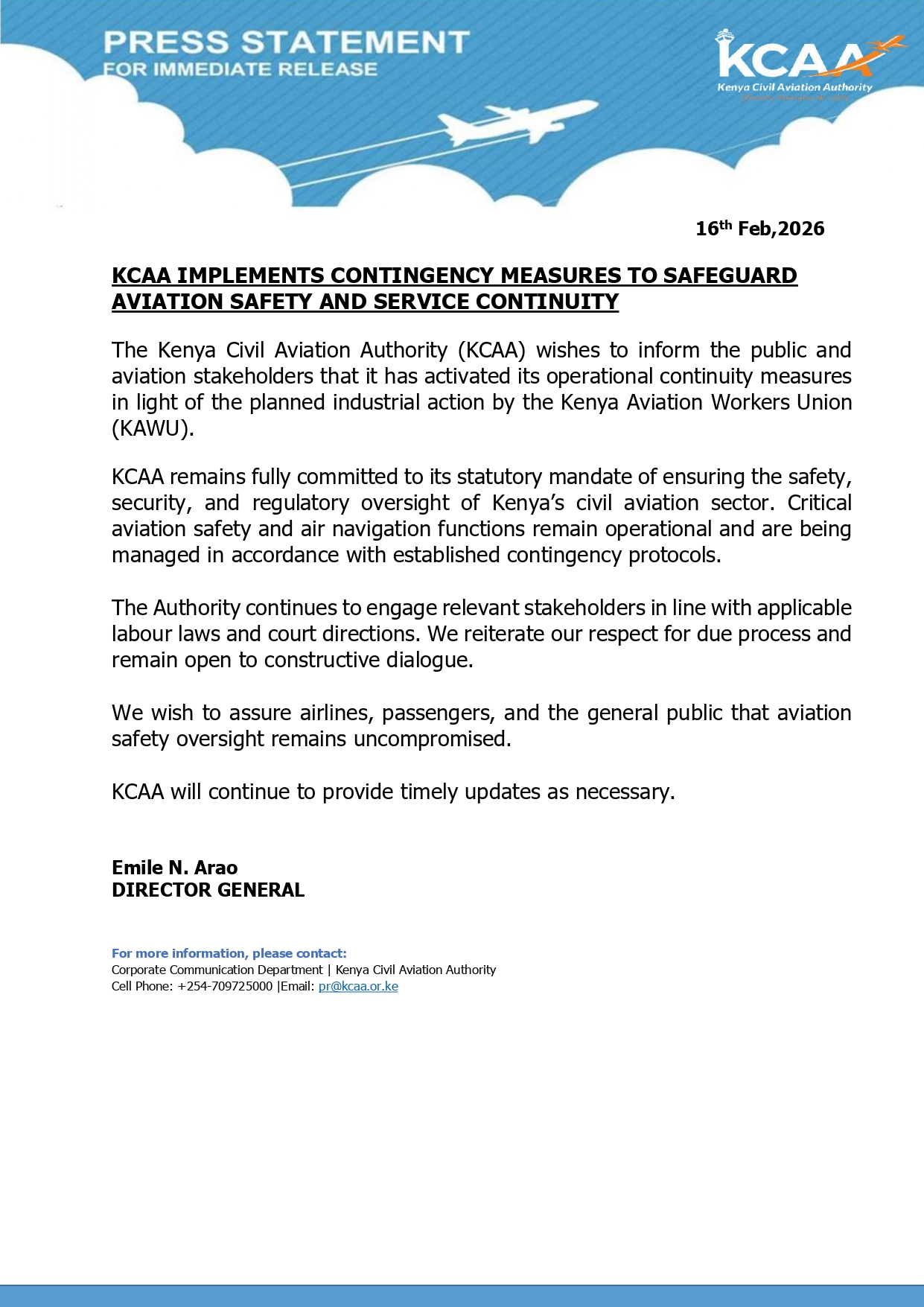
- On 16 February, KCAA:
- Activated contingency measures to protect safety and air navigation.
- Admitted there were passenger backlogs and said recovery of flight operations was underway.
- Advised passengers to confirm flight details with their airlines before going to the airport.
This means that even though the strike was legally paused, operational disruption still occurred and the system is now in a recovery phase.
What is happening at JKIA right now (Feb 17, 2026)
As of 11:00 AM this morning, flight operations at Jomo Kenyatta International Airport (JKIA) were still severely disrupted for the second day in a row, as Kenya Civil Aviation Authority (KCAA) workers continued their industrial action, leading to widespread cancellations, delays, and diversions that left hundreds of passengers stranded.
The operational reality
- Current Status on Feb 17: Flight cancellations and delays affecting both departures and arrivals, with disruption amplified by air traffic control operational delays.
- The dispute is a labour conflict centered on unresolved issues with KCAA, including failure to conclude a collective bargaining agreement (CBA).
- Kenya Airports Authority (KAA) has said it is implementing contingency measures to minimize disruption and has signaled openness to dialogue.
Passenger conditions on the ground
From February 16th, thousands of passengers were stranded, restricted terminal access, and long waits with limited information—classic symptoms when ATC or key operational roles become constrained.
As of Feb 17, multiple flight-tracking sources show over 100 scheduled departures from NBO/JKIA today (example: 108 scheduled departures in one schedule dataset).
Examples of airlines and flights appearing in the Feb 17 schedule:
Flight-tracking snapshots show scheduled or active operations involving airlines such as:
- Kenya Airways (multiple regional and long-haul flights listed although most are delayed by up to an hour)
- British Airways (e.g., BA64 listed in tracking output)
- Air France (e.g., AF815 listed)
- Emirates (e.g., UAE722 listed)
- KLM (e.g., KLM566 listed)
- Flydubai (e.g., FDB1582 listed)
- Regional operators appearing in tracking snapshots (examples include Uganda Airlines / Air Tanzania-coded services in the feed).
What airlines are saying (operational advisories)
- Kenya Airways has publicly advised passengers to check flight status before traveling to the airport due to ATC operational delays and schedule adjustments.
- Precision Air citing Air Traffic Control delays affecting arrivals/departures.
There is a meaningful difference between scheduled and reliably operating. Treat today as “operations with elevated delay risk,” not a full shutdown—unless your specific flight is marked cancelled.
Helpful Info for Passenger in Light of the JKIA Strike
If you have a flight today (Feb 17)
- Despite several airlines being delayed, it seems that most flights especially Kenya Airways are delayed and not cancelled. You can go to JKIA but do confirm (status + check-in availability).
- Use at least two independent checks:
- Airline flight status page/app (first source of truth for your ticket).
- Independent tracker (FlightAware / FlightStats / Flightradar-style boards) to see systemic delay patterns.
- If you must travel to the airport:
- Arrive with extra buffer.
- Carry essentials: water, power bank, snacks, meds, baby supplies.
- Prepare for delayed baggage handling and long queues.
If your flight is delayed (but not cancelled)
- Ask the airline to clarify:
- New estimated departure time.
- Whether you must remain “checked in” to keep your seat.
- Connection protection if you’re transiting through a hub.
If your flight is cancelled
- Request in writing: cancellation reason, rebooking options, and refund pathways.
- Ask for reroute options through alternate hubs if time-critical (Addis Ababa, Entebbe are commonly used for East Africa reroutes—availability depends on ticket and interline rules).
If you are transiting via JKIA
- Your risk is magnified because delays cascade. Use the “minimum connection time” logic:
- If you are self-connecting (separate tickets), assume you may need to re-check bags and clear controls—avoid tight connections.
If your visa or immigration status is affected
If you have a visa validity because of the flight delays/cancellations at JKIA:
- Request written documentation from airline/airport authorities acknowledging disruption.
- Contact your airline and, where applicable, immigration authorities for guidance.
Refunds, rebooking, compensation, and chargebacks
Because strike-related disruption can fall into different policy buckets (force majeure vs controllable disruption), outcomes vary by airline and fare rules. Your best leverage comes from process discipline:
What to do immediately
- Keep screenshots of:
- Cancellation notice / delay status.
- Boarding pass / ticket receipt.
- Rebooking offers and any fee waivers.
What to ask for
- Rebook on next available flight (same airline).
- Rebook via partner/interline (if your fare supports it).
- Refund if travel is no longer viable.
Payment recourse
- If the airline refuses a refund where one is contractually due, chargeback may be an option depending on your card scheme and documentation—use cautiously and only after you’ve documented the airline’s final position.
(For precise compensation entitlements, you must apply the airline’s contract of carriage + any relevant consumer protection rules. Policies differ materially.)
JKIA strike history (2011–Feb 2026)
2011 – Airport/Aviation Workers Strike
- Issue: Pay and working conditions.
- Impact: Partial paralysis of JKIA for at least 2 days.
- How it ended: Government/management negotiations; short, pressure-driven action rather than prolonged shutdown.
- Expert note: Early example of CBA-cycle disputes surfacing through short, high-impact stoppages.
2012 – Kenya Airports Authority (KAA) Staff Strike
- Issue: Salary structure and CBA renewal (25% demand vs lower offer).
- Impact: Delays to domestic flights, uncertainty at JKIA.
- How it ended: Management declared strike illegal + contingency operations → rapid normalization.
- Expert note: Shows essential-services leverage limits duration of airport-worker strikes.
2015 – Aviation Workers Strike Threat (Including ATC)
- Issue: Delayed CBA implementation and backdated pay rise at KCAA.
- Impact: No disruption (strike called off before start).
- How it ended: CBA signed after urgent talks.
- Expert note: ATC involvement forces fast settlement due to safety and airspace risks.
2016 – Kenya Airways Pilots Strike (Planned)
- Issue: Airline governance and labour dispute.
- Impact: No shutdown (court barred strike before it began).
- How it ended: Court injunction + negotiations.
- Expert note: Courts are routinely used to contain aviation strikes before operational collapse.
March 2019 – KAWU / Airport Workers Strike
- Issue: Opposition to JKIA management restructuring plan.
- Impact: Flights grounded, delays, diversions; severe but short disruption.
- Duration: Same-day recovery began.
- How it ended: State intervention + enforcement + negotiations.
- Expert note: Classic high-intensity, short-duration airport strike pattern.
2020 – KAA/Aviation Labour Actions (COVID Era)
- Issue: Pay, conditions, staffing pressure.
- Impact: Multi-day disruption signals reported in sector.
- How it ended: Court/legal pressure + return-to-work dynamics.
- Expert note: Pandemic stress amplified labour–fiscal tension in aviation.
November 2022 – Kenya Airways Pilots Strike
- Issue: Retirement savings fund / benefits dispute.
- Impact: Major KQ network disruption; airline reported heavy daily losses.
- Duration: 4 days.
- How it ended: Court ordered pilots back to work with non-retaliation protections.
- Expert note: Airline-specific strikes last longer than airport-worker strikes due to narrower but stronger leverage.
September 2024 – KAWU Strike (Adani/JKIA Lease Dispute)
- Issue: Fear of job losses and foreign control under proposed JKIA lease/PPP.
- Impact: Delays and cancellations at JKIA and other airports.
- Duration: ~1 day.
- How it ended: Same-day return-to-work deal + assurances of no victimization + document review.
- Expert note: Policy/asset-control disputes trigger short, politically targeted strikes.
February 2026 – KAWU vs KCAA Strike (Current)
- Issue: CBA not concluded since 2015 + union dues deduction dispute.
- Impact: Delays, backlogs, recovery operations activated despite court orders.
- How it is being managed: Court injunction + contingency operations + phased recovery.
- Expert note: This is a structural, long-running CBA conflict, not a one-off wage dispute—hence higher systemic risk.
Overall Pattern (2011–2026)
- Airport/aviation worker strikes in Kenya are usually short (hours to 1–2 days) due to safety, legal, and economic pressure.
- ATC or safety-critical roles force rapid court or political intervention.
- Airline pilots’ strikes last longer (days) because leverage is concentrated within one carrier.
- Most disputes end via: court orders, emergency negotiations, and non-victimization return-to-work deals.
- Unresolved CBA cycles (like 2015–2026) are the main structural trigger for repeated crises.
Conclusion: What to Expect Next
While the current JKIA disruption has been frustrating for passengers, history offers some reassurance. Over the past 15 years, most airport and aviation worker strikes in Kenya have been short-lived, often lasting hours to a day or two before court orders, emergency negotiations, and operational contingency plans force a return to normal service. Even high-impact actions in 2019 and 2024 were resolved within a day, and longer disputes have typically been confined to airline-specific strikes rather than airport-wide shutdowns.
Given this pattern—and with the court already involved, KCAA’s contingency measures in place, and recovery operations underway—it is reasonable to expect this disruption to ease quickly, potentially within the next day if past precedent holds. That does not mean there will be zero delays, but it does suggest a rapid normalization of flight operations rather than a prolonged shutdown.
For passengers, the practical takeaway remains simple: check your flight directly with your airline before traveling to JKIA, allow extra time, and be prepared for minor schedule adjustments. If history is any guide, this will be a short, sharp disruption, not a long-running crisis.
If you’re facing a long layover or a flight cancellation in Nairobi, we recommend checking out our guide with fun things to do during a long NBO layover—and, if time allows, consider turning the wait into a highlight with a Nairobi National Park layover tour just minutes from the airport.
More helpful resources on the on-going strike at the NBO:
- Check the Official Twitter/X account of Kenya Airports Authority for the Latest Updates.
- Check Kenya Airways’ official travel alerts page for the latest info or find details on rebooking your KQ flight here.
- See current JKIA flight departures (scheduled, delayed & canceled)
- See flight arrivals at NBO (including all scheduled, landed, delayed and canceled)
4 PM Update: JKIA Operations Resume After Strike Is Called Off
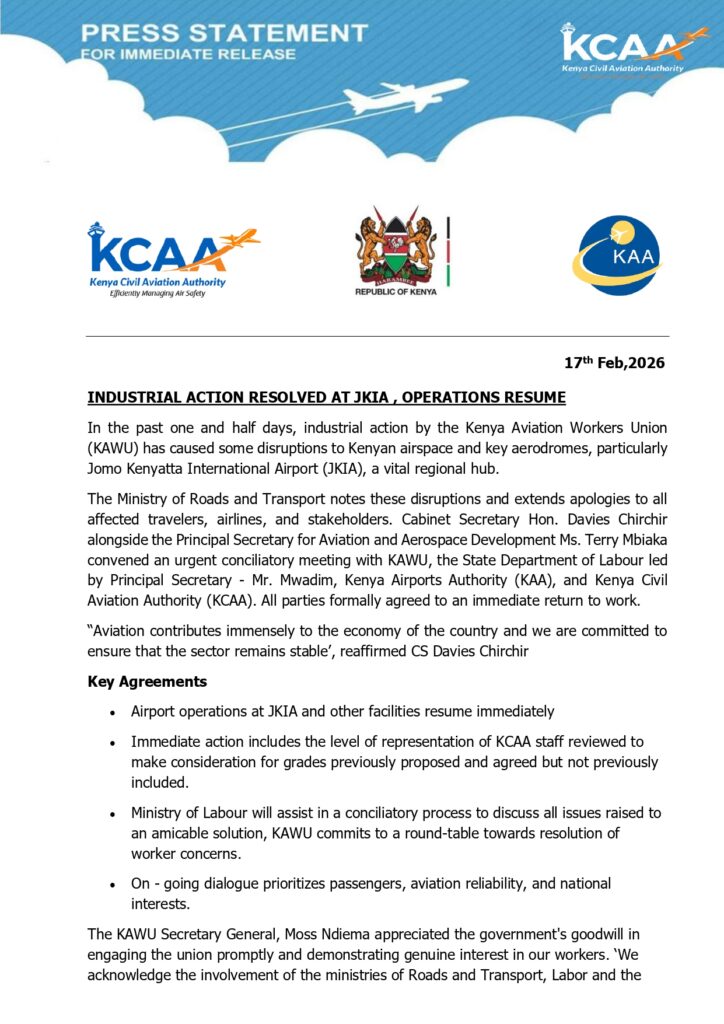
At around 4:00 PM today, the Kenya Civil Aviation Authority (KCAA) announced that the industrial action by the Kenya Aviation Workers Union (KAWU) had been resolved, paving the way for a full resumption of operations at Jomo Kenyatta International Airport (JKIA) and other affected airports.
Following an urgent conciliation meeting involving the Ministry of Roads and Transport, the Ministry of Labour, KCAA, and the Kenya Airports Authority (KAA), all parties agreed to an immediate return-to-work formula. The government issued an apology to passengers and airlines for the disruption, and confirmed that a structured dialogue process will continue, led by the Ministry of Labour, to address outstanding worker concerns.
Key outcomes include the immediate reopening of airport operations, a review of staff representation and grading issues, and a commitment to ongoing talks that prioritise passenger service, aviation reliability, and national interest. Authorities reaffirmed that aviation remains critical to Kenya’s economy through tourism, trade, cargo, and jobs, and emphasized the importance of stability in the sector.
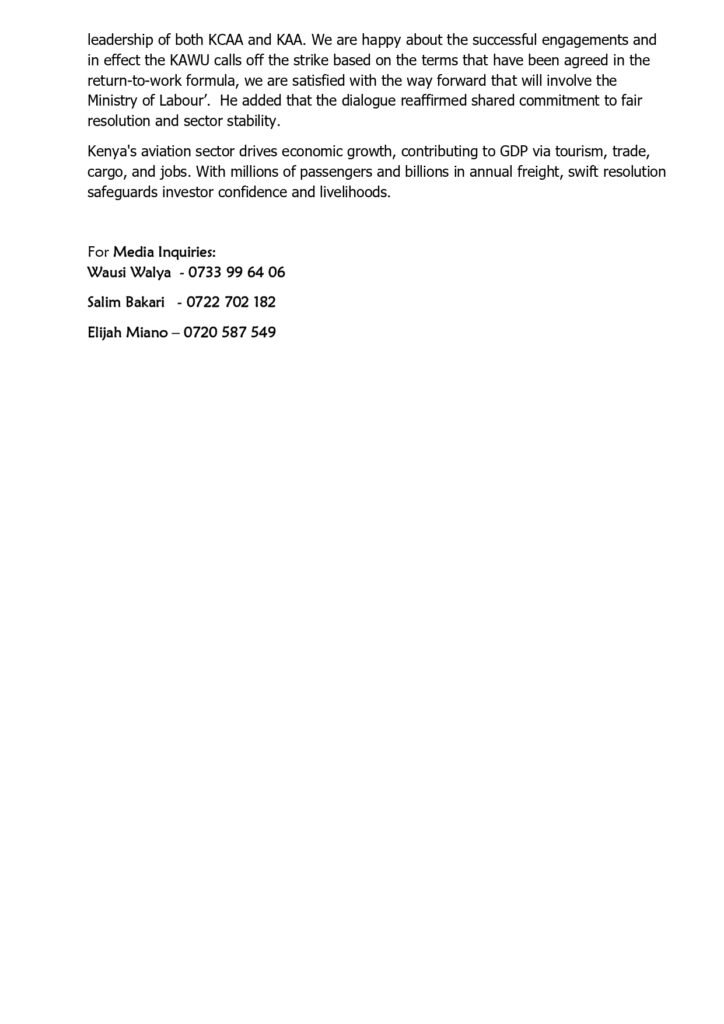
Passengers are advised to check with their airlines for updated flight schedules as services normalize.
Below are the press statements from KCAA released an hour ago: